Key Points
Question: Does inhaled epoprostenol (iEPO) or inhaled nitric oxide (iNO) result in greater improvements in partial pressure of oxygen to fraction of inspired oxygen (PaO2:FiO2) ratio in mechanically ventilated patients with COVID-19 and moderate to severe acute respiratory distress syndrome (ARDS)?
Findings: The maximum change in PaO2:FiO2 ratio within 24 hours was significantly greater in the iNO group compared to iEPO. Secondary analyses indicated that iNO reduced inpatient mortality but was associated with longer length of hospital stay.
Meaning: The results of the study indicate that iNO resulted in greater improvements in oxygenation compared to iEPO. Inpatient mortality was lower in the iNO group; however, mortality rates were high in both groups and reflect the severity of COVID-19-induced ARDS during the study period.
Introduction
Treatment of patients with COVID-19 and moderate to severe acute respiratory distress syndrome (ARDS) requiring mechanical ventilation (MV) includes lung protective ventilation, conservative fluid administration, prone positioning, neuromuscular blocking agents (NMBA), corticosteroids, and immunomodulators.1 Despite a lack of prospective trials of inhaled vasodilators in patients with COVID-19 ARDS, the National Institutes of Health (NIH) suggest a trial of inhaled nitric oxide (iNO) as a rescue therapy when other efforts to improve oxygenation have failed. Although the use of inhaled epoprostenol (iEPO) as a rescue therapy for COVID-19 ARDS is not mentioned in the NIH guidelines, the lower cost of iEPO relative to iNO, ease of administration, and noted improvements in PaO2:FiO2 in non-COVID-19 ARDS and COVID-19 ARDS make iEPO an attractive alternative to iNO.1,2 However, published data involving iEPO in COVID-19 ARDS is limited by small sample sizes, lack of comparative studies with iNO, mixed patient populations of non-COVID-19 and COVID-19 ARDS, and use of crossover trials in centers that reserve iNO for patients that failed initial iEPO.3,4 Therefore, we created this study to compare the clinical impact of iEPO and iNO in adult MV patients with moderate to severe COVID-19 ARDS.
Materials and methods
Study Design and Population
This was a retrospective cohort study conducted at 11 hospitals within the same healthcare system in Arizona, Colorado, and Wyoming. The healthcare system maintained a living document with recommendations for treatment of COVID-19 as published data became available and inhaled vasodilators were suggested as a rescue therapy in patients with severe hypoxemia with iEPO suggested as the preferred therapy. However, treatment of COVID-19, including selection of iEPO or iNO, was at the discretion of the provider. This study was approved by the University of Arizona Institutional Review Board.
Inclusion and Exclusion Criteria
Patients ≥18 years with a documented diagnosis of COVID-19 requiring mechanical ventilation and moderate to severe ARDS, defined as a PaO2:FiO2 ratio <150 mmHg, who received continuous iNO or iEPO for ≥1 hour were eligible for inclusion. Key exclusion criteria included patients receiving >2 hours of concomitant iEPO and iNO, use of iNO or iEPO for pulmonary embolism, concomitant administration of parenteral prostacyclins, extracorporeal membrane oxygenation (ECMO) prior to iNO or iEPO administration, and patients without an arterial blood gas (ABG) at baseline or within 6 hours of study drug initiation.
Data Collection
Data collection included baseline demographics, comorbidities, hemodynamic parameters, vasopressor requirements, renal replacement therapy (RRT), adjunctive medications for COVID-19, and baseline Sequential Organ Failure Assessment (SOFA) score. Data for PaO2 and FiO2 were collected at baseline and time intervals of 0-6, 6-12, 12-24, 24-48 hours after initiation of iNO or iEPO. All data was abstracted from the electronic medical record by two authors (JAJ, SM).
Statistical Analysis
Chi-square testing was used for evaluating categorical variables and independent sample Student t-testing was used for continuous variables. A multivariable logistic regression analysis was performed to assess the relationship between mortality and explanatory variables including study drug, weight, ethnicity, prone positioning, NMBA, and ECMO. Assuming a power of 80% and alpha of 0.05, a total of 200 patients was needed to detect an absolute increase in PaO2:FiO2 of 10 mmHg within 24 hours of study drug initiation. A p-value of <0.05 was considered statistically significant. Data was analyzed using STATA version 16.1.
Study Outcomes
The primary endpoint was the maximum change from baseline in PaO2:FiO2 in the 24 hours following initiation of iEPO or iNO. Secondary outcomes evaluated included inpatient mortality and hospital length of stay.
Results
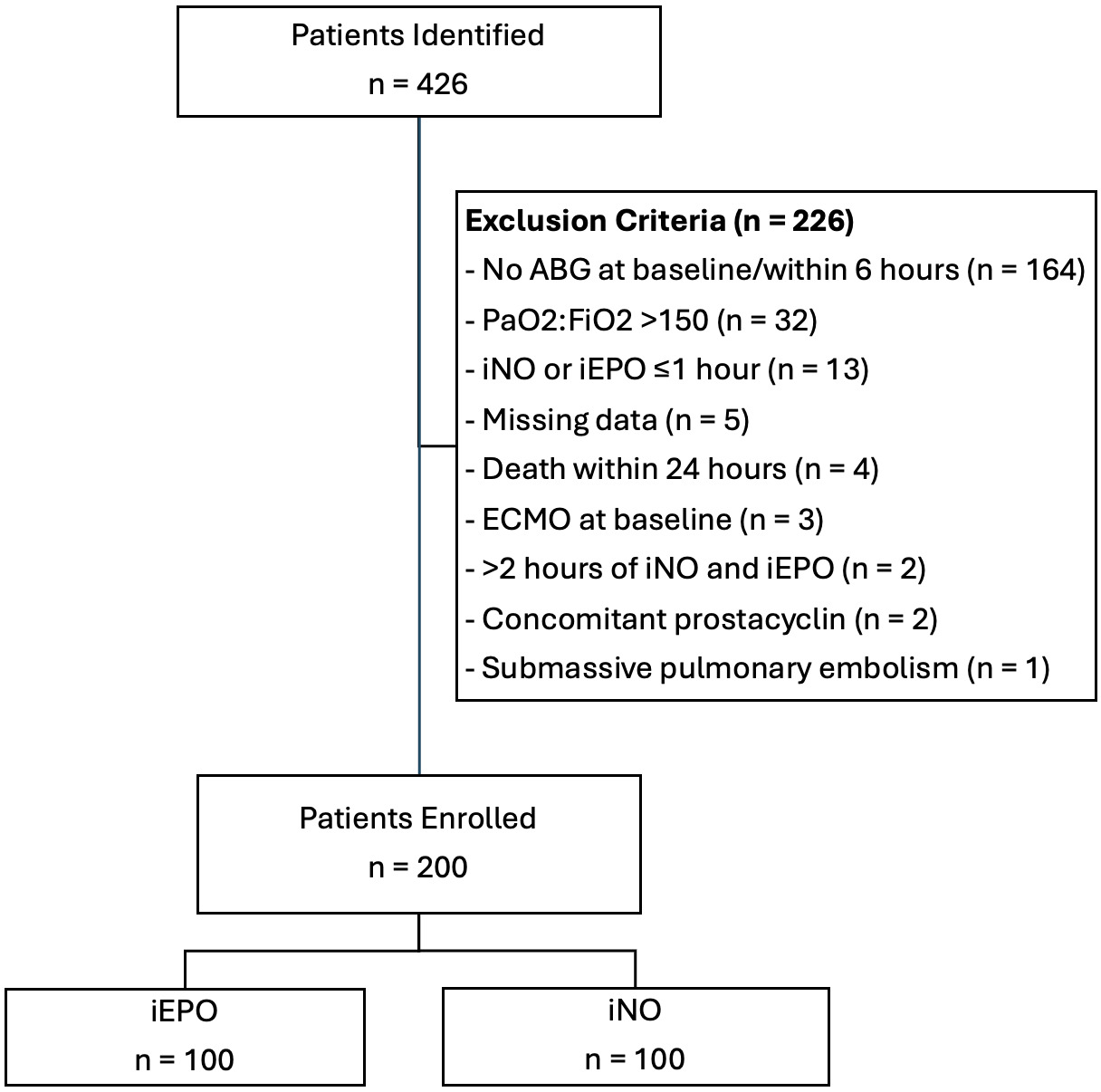
There was a total of 426 patients screened for inclusion with 226 patients who met exclusion criteria (Fig. 1).
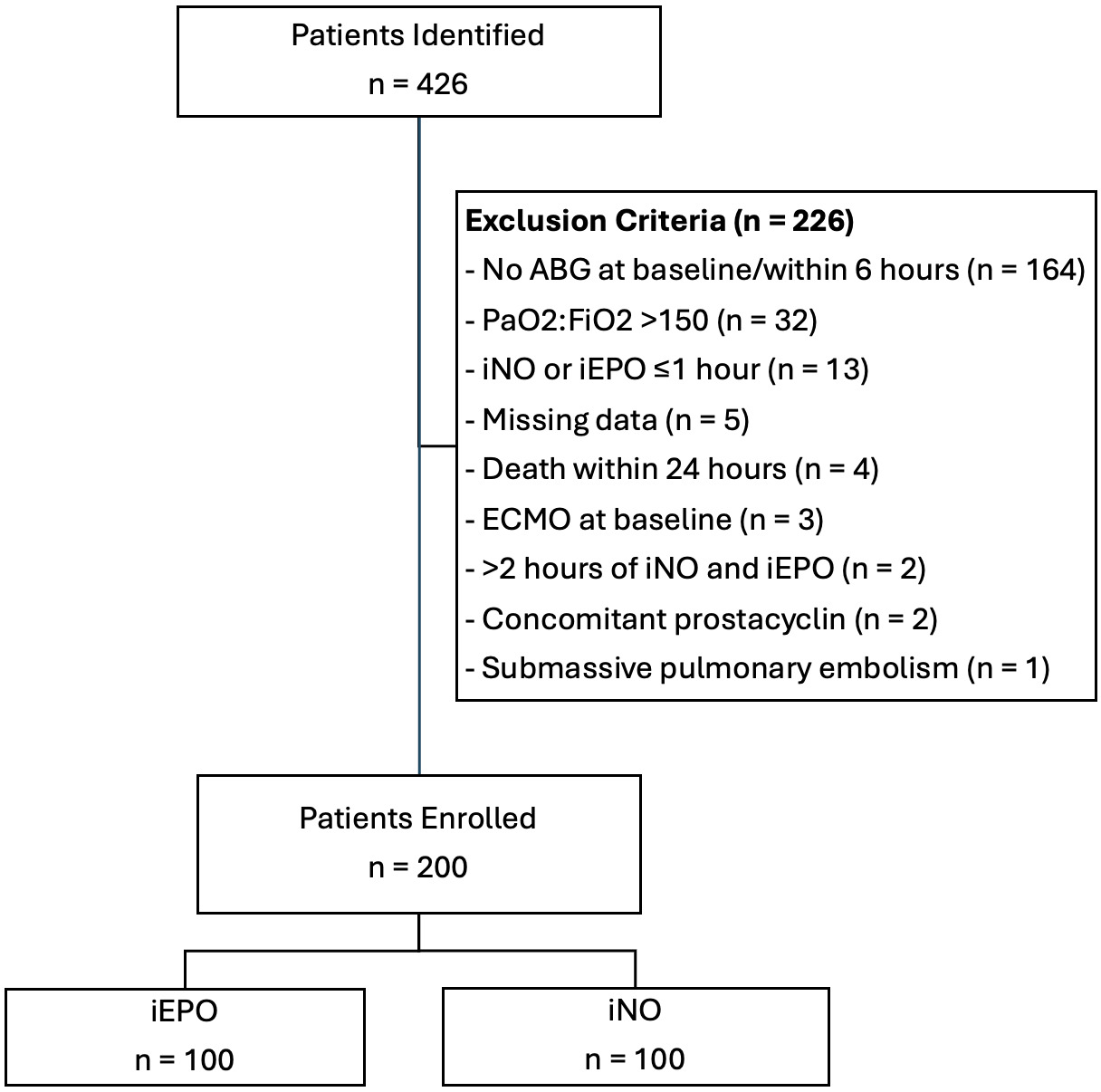
Two hundred patients were enrolled in the study, with 100 patients in each group. Baseline characteristics were similar between groups except for higher weight (p = 0.042) and MAP (p = 0.049) in the iEPO group and higher utilization of ECMO after study drug initiation in the iNO group (Table 1). The mean dose of iEPO was 28.1 ng/kg/min and the mean dose of iNO was 17.7 ppm.
The mean maximum change in PaO2:FiO2 ratio within 24 hours from baseline was greater in the iNO group compared to the iEPO group (62.7 vs 40.7 mmHg, p = 0.019) (Table 2).
Inpatient mortality was higher in the iEPO group compared to the iNO group (91% vs 72%, p < 0.001). The mean length of hospital stay was longer in the iNO group compared to the iEPO group (28.3 vs 18 days, p = p < 0.001). Logistic regression analysis revealed that use of iNO (OR, 0.27; 95% CI, 0.113 to 0.645) and initiation of ECMO after study drug (OR, 0.133; 95% CI, 0.028 to 0.636) were predictive of lower mortality, while increasing doses of norepinephrine equivalents (OR, 1.05; 95% CI, 1.004 to 1.090) were associated with higher mortality (Table 3).
Discussion
The use of iNO was associated with greater increases in PaO2:FiO2 and lower mortality compared to iEPO in a group of adult patients with COVID-19 with moderate to severe ARDS. Notably, approximately 92.5% of the patient population enrolled had severe ARDS at baseline. In logistic regression, use of iEPO remained an independent risk factor for mortality in this population. Patients in the iNO group had significantly longer hospital length of stay, which may represent survival bias.
The use of inhaled vasodilators has traditionally been reserved as a rescue therapy for severe hypoxemia with documented improvements in oxygenation.2,5 A recently published meta-analysis of inhaled prostacyclins reported an improvement in PaO2:FiO2 ratio by a median of 19.45 mmHg in patients with COVID-19 ARDS compared to 40.7 mmHg in iEPO patients in this study.2 In iNO treated patients with COVID-19 ARDS, a prospective trial reported an improvement in PaO2:FiO2 at 48 hours of 23.3 mmHg while a retrospective trial reported a median improvement of 106.9 mmHg at 24 hours.6,7 In this study, the mean maximum change in PaO2:FiO2 was 62.7 mmHg. Differences in changes in PaO2:FiO2 may be explained by variable severity of ARDS, differences in utilization of prone position, or differences in recruitment maneuvers.4,8 A recently published article provided evidence that COVID-19 infection may reduce endogenous NO and explored the correlation between decline in NO levels and COVID-19 severity.9 Perhaps, this could also explain why patients who were administered iNO responded more favorably.
The use of inhaled vasodilators has not been associated with reductions in mortality; however, most studies involve non-COVID patient populations.2,5 In COVID-19 patients with ARDS, there is a lack of data comparing mortality between those treated with iEPO and iNO. This study found a reduction in mortality with iNO compared to iEPO. In multivariate logistic regression, the use of iEPO remained an independent risk factor for mortality. There may be physiologic rationale for why iNO reduced mortality, including antiviral, anti-inflammatory, and anti-thrombotic effects associated with iNO.6,10 Other independent variables associated with lower mortality included the use of ECMO. In contrast, norepinephrine dose was independently associated with higher mortality (Table 3).
To our knowledge, this is the first study demonstrating demonstrating an association in oxygenation parameters and mortality favoring iNO over iEPO in patients with COVID-19 associated ARDS. Given the findings of this study along with the physiologic rationale that could explain these outcomes, this study suggests that iNO should be used preferentially over iEPO when managing ARDS associated with COVID-19 infection.
Several limitations should be mentioned. Our study was retrospective in nature and ABGs were not drawn on a consistent basis. In addition, mortality rates were high in both groups and the study was completed during the peak of COVID-19-related deaths. Therefore, the data may not be generalizable to current strains of SARS-CoV-2 that are associated with lower mortality. It is possible that ECMO use was confounder to the outcome of mortality since there were more patients on ECMO in the NO group and the multivariate analysis found ECMO to be an independent variable associated with reduced mortality. Finally, despite completing a multivariate regression analysis, it is possible that unaccounted for variables were responsible for the reductions in mortality in the iNO group.
Conclusions
In patients with moderate-to-severe ARDS due to COVID-19, iNO significantly improved PaO2:FiO2 ratios and reduced mortality compared to iEPO. Prospective trials comparing iNO to iEPO are required to confirm the findings of our study.
Acknowledgements
The authors have no acknowledgements.
Conflicts of Interest
The author(s) declared no potential conflicts of interest with respect to the research, authorship, and/or publication of this article.