Introduction
Emergency department (ED) revisits are defined as a patient presenting to the ED for the second time within 72 hours or 30 days of discharge. The early ED revisit rate is regarded as a quality of care indicator and a tool for improving patient care in the ED.1 Medication non-adherence is one of the main contributing factors in ED revisits.2 A previous study conducted by Santalo and colleagues showed how Automated Pharmacy Systems (APS) can prevent prescription abandonment by 30%.3
Timely and safe medication access at hospital discharge is an enduring challenge, especially in the ED setting. “Meds-to-beds” programs, where patients receive their prescribed medications directly before discharge, have gained prominence as a strategy to improve medication adherence and streamline transitions of care.4
Patient satisfaction is increasingly recognized as a critical outcome in evaluating healthcare interventions. High satisfaction correlates with better adherence, fewer post-discharge complications, and improved trust in the healthcare system.5 Integrating automated pharmacy kiosks into the ED discharge process is a novel approach to delivering these benefits in a high volume and fast-paced environment.
Meds-To-Beds Kiosk Reintroduction
The Adherent 360 application was the APS utilized in the EDs evaluated in this study. The formulary for the kiosks was developed based on historical prescribing trends and approved by emergency medicine physicians. Medications were loaded if commercially available or prepackaged to fit the APS, which holds 700–800 units and is affiliated with the outpatient pharmacy for compliance. At discharge, patients opting into the ED meds-to-beds program followed a workflow where providers entered kiosk prescriptions in the electronic health record (EHR), pharmacists verified prescriptions, and nurses retrieved, scanned, and prepared medications for final pharmacist verification before delivery with discharge paperwork. Payment and counseling were managed by personal financial specialists (PFS) and pharmacy as needed. Staffing models for physicians, nursing, and PFS remained unchanged, while the campus pharmacy team oversaw both kiosks, handled prepacking and inventory, and allocated 0.5 pharmacy technician and pharmacist blended rates based on utilization or productivity. The pharmacy process was owned by the inpatient pharmacy team since the program was a 24-hour service.
Building on part one,2 which established the feasibility and acceptability of medication kiosks in the ED, this study is a continuation that evaluates the impact of the kiosk program on patient satisfaction and explores its potential role in reducing ED revisits. The APS workflow and formulary items are consistent with the novel study. By providing medications conveniently at discharge, the program aims to enhance patient experience, promote medication adherence, and ultimately reduce preventable return visits.
Methods
This study was conducted in a 24-bed off-site emergency department (OSED) and a 20-bed parent-campus emergency department (CED) of an 80-bed hospital in central Florida. This OSED sees over 25,000 patients and sends over 37,000 prescriptions annually. The CED sees over 27,000 patients and sends over 32,000 prescriptions annually. At this OSED, 40% of the patient population is Medicaid/Self-pay compared to 15% of patients at the CED being Medicaid/Self-pay while having similar acuity levels. Data were collected from visits between July 15-August 12, 2025 to ensure there was a complete 30-day follow-up period for assessing ED revisits within the dataset and a follow-up phone survey. A non-public database that included medical record numbers, was utilized for the tracking of ED visits and admissions in the past. The purpose of the study was to evaluate the effect of medication kiosks in the ED on patient experience and ED revisits.
Methods for ED revisit arm
This was a retrospective quality improvement analysis of data from the OSED and CED. Patients were randomized for retrospective chart review and had visited either ED within the study time period who left with or without a prescription. Patients were excluded from the study if they were admitted upon initial visit or if they did not have a disposition diagnosis. Patients who left against medical advice were still included in the study if they had a disposition diagnosis. The primary outcome for this arm was all-cause ED revisits within 72 hours or 30 days. ED revisit was defined as the patient returning to the ED for any cause within the 72 hour or 30-day observation period. Additional data collected included relatedness of revisit within 72 hours and 30 days, relatedness of revisit diagnosis to diagnosis on initial visit, revisit leading to hospital admission, ED revisit history in previous 90 days, hospital admission history in previous 90 days, number of prescriptions prescribed, presence of polypharmacy (≥5 meds/day), payor group used, ED acuity number and class, and ED length of stay were the outcomes collected. The secondary outcome was a 30-day ED revisit cost avoidance analysis for the entire division of the health-system. Campus financial and ED leadership deemed the department’s expense per each ED revisit costs $1,200. Fisher’s exact test was utilized in the analysis of data collected due to its benefit with smaller sample sizes and ability to provide an exact probability. The required sample size was calculated to be 244, with a margin of 5% error and a 90% confidence interval.
This study was determined to be exempt from institutional review board review as a quality assurance/quality improvement (QAQI) activity and retrospective chart review.
Methods for kiosk patient satisfaction arm
The survey employed a cross-sectional design to assess patient experience and satisfaction with medication delivery prior to hospital discharge. A total of 133 patients who received care and utilized the kiosk across two ED were identified and contacted by phone to conduct the survey. The survey consisted of five structured questions addressing the following: (1) does the patient have a preferred community pharmacy, (2) mode of transportation to pick up medications (self, family member, etc.), (3) perceived convenience of having prescriptions delivered directly to the hospital room before discharge, (4) self-reported estimated time saved by utilizing the medication kiosk and (5) perceived overall satisfaction of patient with delivery of medication. The interviewer assessed using a 5-point scale ranging from very unsatisfied (1) to very satisfied (5), with intermediate points representing unsatisfied (2), neutral (3) and satisfied (4). The survey was pre-tested and pilot tested when 10% of the total participants responded to the survey. A separate governance panel who were familiar with the survey design evaluated the results. The panel validated the survey for its ability to measure the purpose of the study. Convenience and satisfaction were analyzed using a one-sample Wilcoxon signed-rank test to compare distribution of scores (1-5) against a neutral response (3).
Survey administration was done by pharmacy personnel, and responses were recorded utilizing a standardized script and data collection form. Patients were included if they had used the medication kiosk during the selected study period. Patients who could not be reached after more than two attempts, declined participation or did not speak English or Spanish were excluded from the study, due to limited availability of translation services.
Results
During the studied timeline, the OSED had 2,174 ED visits with 3,093 prescriptions sent while the CED had 2,220 ED visits with 2,730 prescriptions sent. The OSED kiosk had a prescription capture rate of 28.8% and the CED had a prescription capture rate of 32.3%. Baseline demographic data and outcomes are shown in Table 1. A total of 309 patients were evaluated during the observation period, with 154 being kiosk users. With use of the kiosk, 72-hour revisits were reduced by 1.9% when compared to non-kiosk users (95% CI, 0.20-1.93, p-value 0.57). For 30-day revisits, there was a 3.2% reduction in revisits seen in the kiosk group (95% CI, 0.42-1.46, p-value 0.53). In the ED revisit cost avoidance analysis, the health-system division in which these EDs were evaluated had a total of 65,014 ED visits within the 20 EDs in the past 12 months. At a 30-day ED revisit reduction of 3.2%, the health-system can avoid $2,497,200 due to the expenses of the ED revisits. All data is referenced in Table 2.
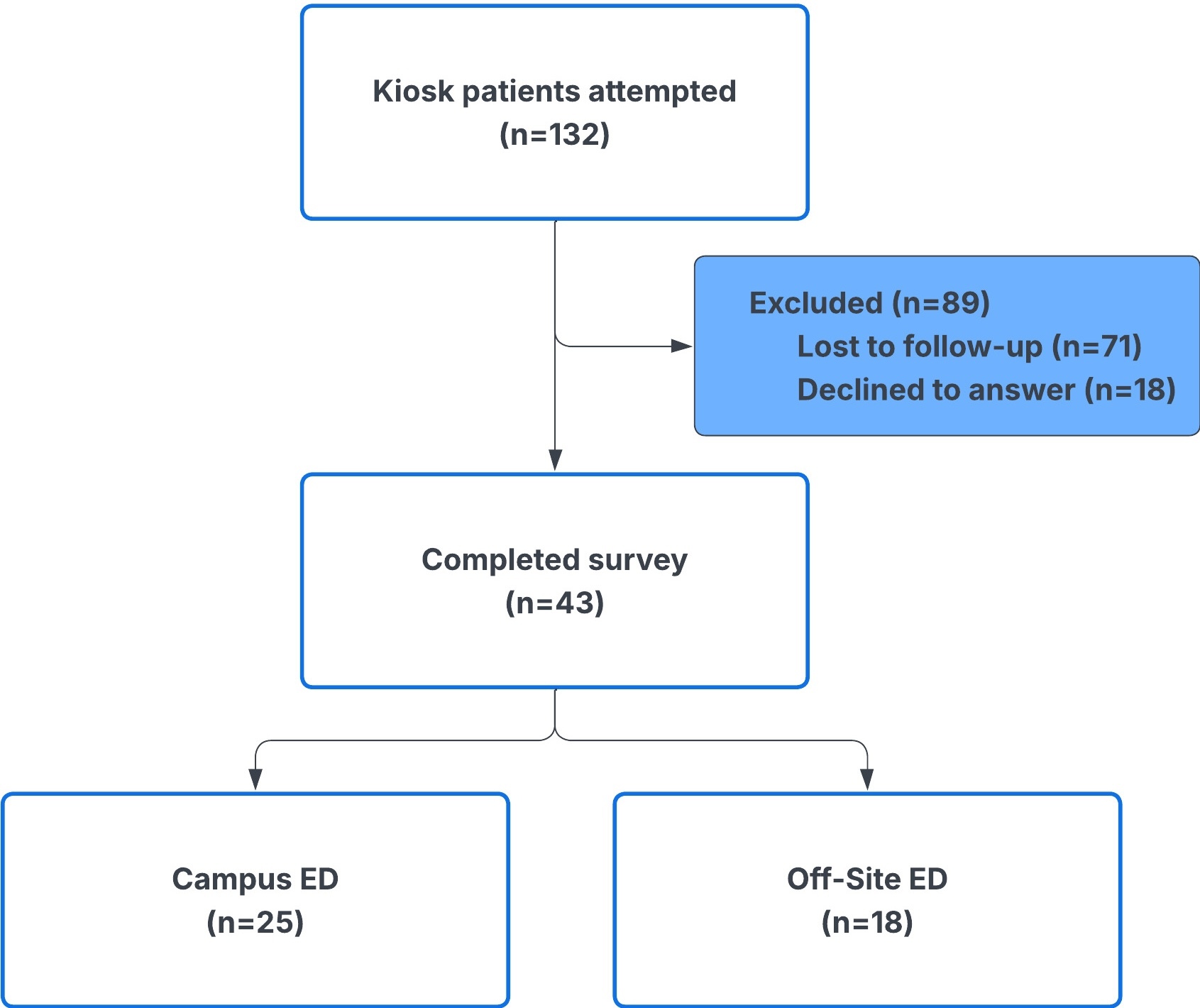
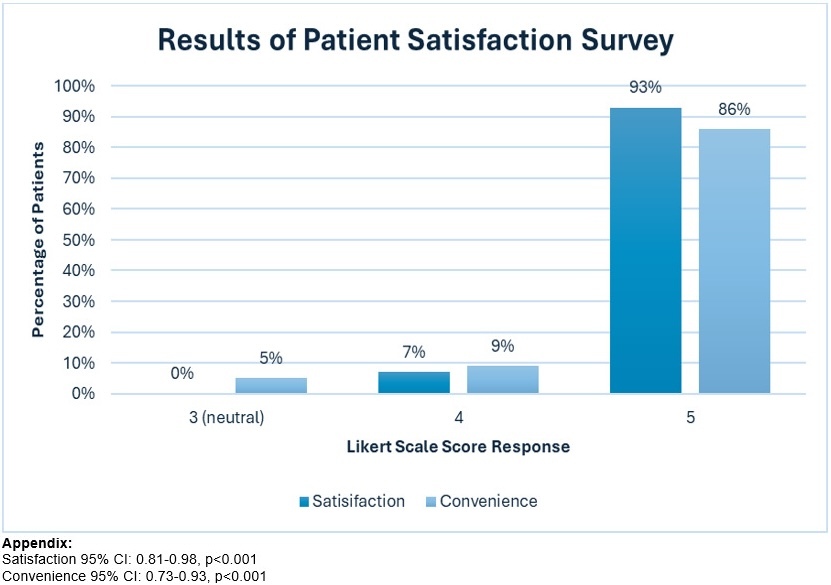
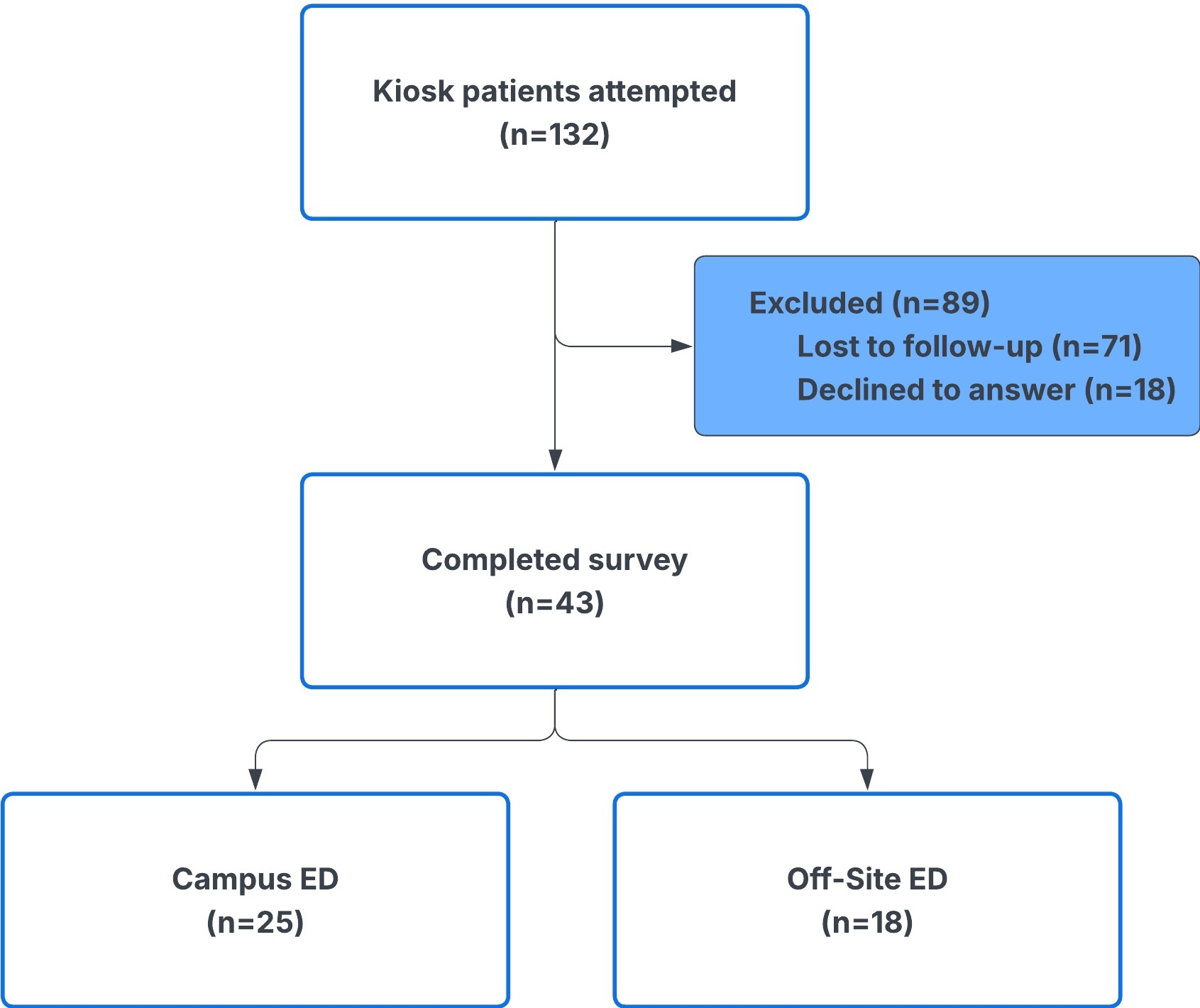
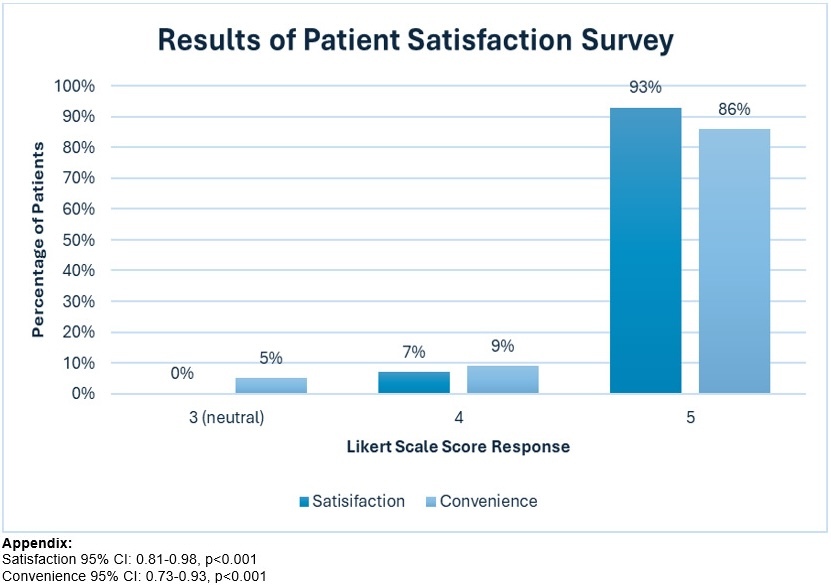
A total of 132 patients were contacted and 43 completed the survey, giving a 32% response rate as shown in Figure 1. A total of 86% patients (95% CI, 0.73-0.93) reported having a preferred community pharmacy where they would pick up their routine prescriptions from. Regarding the convenience of having the medication delivered to their hospital room, a total of 86% of patients (95% CI, 0.73-0.93) rated the medication kiosk service as “extremely convenient.” Convenience and satisfaction scores were significantly higher than the neutral score of 3 with a p < 0.001 showing very high positive ranks as shown in Figure 2.
Discussion
Implementation of a kiosk did show a positive patient experience and reduction of ED revisits. Since the previous study, the capture rate has increased due to the application’s ability to adjudicate claims. This increased our capture rate by over 20%. Our findings through the analysis of 309 EHRs indicated that patients who utilized the ED medication kiosk on discharge were less likely to revisit the ED within 72 hours and 30 days from the initial encounter. In particular, patients who did not use the kiosk on discharge were associated with a higher likelihood of revisit in relation to their primary diagnosis. This is highlighted in Sah, et al’s study, where illness-related revisits made up 56% of their total population. With the use of these kiosks, it is not only for increased access to discharge medications, but it has also shown to reduce expenses by over $2 million for the health-system if the program expanded.6
Although reductions in 72 hour and 30 day ED revisits did not reach traditional thresholds for statistical significance, the observed directional trends remain operationally and financially meaningful when considered at scale. From a health-system perspective, even modest non-significant reductions in revisit rates can translate into substantial downstream impact when applied across high-volume ED populations. In this analysis, kiosk utilization was consistently associated with fewer illness-related revisits, aligning with prior literature that identifies medication access as a key driver of preventable return encounters. When coupled with the greater than 20% increase in prescription capture and the estimated $2.5 million in annual cost avoidance projected with systemwide expansion, these findings highlight an important distinction between statistical and operational significance. For healthcare leaders and C-suite decision-makers, interventions that may fall short of p < 0.05 can still deliver meaningful value by improving access, reducing avoidable utilization, and generating material financial return—particularly in resource-constrained environments where scalability and margin preservation are critical. Explicitly recognizing this gap reinforces the relevance of ED medication kiosks as a strategically sound investment despite the inherent limitations of sample size and statistical power.
The survey achieved a 32% response rate, which is above the acceptable threshold of 30% for survey studies.7 The patient survey conducted of 43 patients showed very high levels of satisfaction and perceived convenience regarding the inpatient meds-to-beds service. Importantly, 86% of patients (95% CI, 0.73–0.93) rated the bedside delivery service as “extremely convenient,” and 93% (95% CI, 0.81–0.98) said they were “very satisfied” with receiving their medications in the hospital prior to discharge. These findings mirror results from prior quality improvement programs which have shown that meds-to-beds initiatives are associated with high patient satisfaction and improved medication access. The ED Consumer Assessment of Healthcare Providers and Systems (CAHPS) is a standardized survey that looks at patients’ experience in the ED with medication information as well as other factors like interactions with doctors, nurses and follow-up care after leaving the ED. Longer wait times are often a reason for lower satisfaction scores. This study found that the median time saved was approximately 2 hours based on the patient’s response. This suggests that the kiosk reduced the total time associated with their ED visit which could enhance satisfaction scores in ED patient surveys. Patients reported that the kiosk was convenient, noting that without bedside medication delivery they would have had to wait several hours to obtain their prescriptions from their preferred community pharmacy since they were being discharged from the emergency department in the middle of the night.
Financially, the campus and OSED kiosks operated at an 11% and 0.7% margin performance, respectively. The payback period for both kiosks is 22 months. Limitations for both kiosks were pharmacy contracts, payer mix, and 340B qualifications. Start up costs, fees, revenue, and expense information were not permitted to be disclosed by the authors.
Future Implications
One area where medication kiosks can have an increased role is by expanding their formulary to include maintenance or critical medications, like Xarelto starter packs. This expansion would allow for patients to leave the ED with refills/maintenance quantities of their medications to prevent interruptions in their therapy. Expanding kiosk access to essential medications for conditions appropriate for outpatient management may help facilitate adherence to prescribed therapy and could contribute to improved clinical outcomes. As medication kiosks assume a greater role in ED operations, they may create new employment opportunities through centralized services or a health unit–based technician (HUT) position piloted in this study. The HUT manages kiosk operations, including retrieving medications for the meds-to-beds program, restocking and maintaining the machines, refilling automated dispensing cabinets (ADCs) used by nurses for admitted patients, and serving in a role similar to a health unit coordinator (HUC) with pharmacy technician licensure who oversees the service. Other implications that could come from these medication kiosks would be supporting patient care by filling in gaps when there is not a 24-hour pharmacy near the ED at discharge. These kiosks allow for patients not to be burdened by late ED discharges and not being able to get their prescriptions filled until the next day. This was highlighted in Chen, et al’s study, when mentioning the benefits of having a pharmacy inside the ED reducing barriers such as cost, transportation, and pharmacy access for patients compared to filling prescriptions at their community pharmacy.8
Limitations
This study had the following limitations that should be noted. First, this study was conducted by a single hospital that oversaw two of these ED medication kiosks, and therefore, the results may not be generalizable to other practice settings. Other than payor group and gender, other patient demographics were not included in the analysis to directly compare kiosk utilization. This was by choice to directly compare kiosk usage rather than other confounders. Second, in reference to our previous study, non-kiosk users had a higher readmit history than kiosk users which differs from our initial study’s findings where the ED revisits were the same within 30 days of discharge. This could be purely up to randomization of ED patients but we did not have the resources to verify if this difference was significant. Third, our survey had a relatively small sample size, likely due to loss to follow-up and limited availability of translation services to conduct the survey in non-English and non-Spanish speakers. The study’s outcomes relied on self-reported measures, recall bias may have influenced how patients evaluated their convenience and satisfaction of their experience with the kiosk. Lastly, the reduction of ED revisits with use of the medication kiosk was found to be not statistically significant, this could be attributed to our small sample size. Ultimately, each health-system would have to review the statutes from their respective states on if and how kiosks can be utilized.
Conclusion
This study evaluated both patient experience and all-cause emergency department ED revisits to better understand the true impact of medication kiosks on patient care. Our findings suggest a reduction in all-cause ED revisits at both 72-hour and 30-day intervals, as well as a decreased likelihood that revisits were related to the primary diagnosis. Implementation of a meds-to-beds kiosk program also has the potential to reduce avoidable ED revisit costs. Patient experience was notably positive, with 93% of patients reporting high satisfaction with the medication kiosks. Given that patient experience is a key priority for many health systems, it is essential to evaluate patient-reported outcomes when introducing new care delivery processes. Overall, our findings suggest that medication kiosks can positively impact both clinical and experiential outcomes.
Funding
This research did not receive any specific grant from funding agencies in the public, commercial, or not-for-profit sectors.
Conflicts of Interest
The authors have nothing to disclose and there were no conflicts of interest.
IRB / Ethics Approval
This research was IRB exempt for QAQI and retrospective chart review.
Author Contributions (CRediT)
Austin Garver: Data curation, Formal analysis, Investigation, Methodology, Writing - original draft, Writing - review & editing. Jacqueline Espinoza Ramirez: Conceptualization, Writing - original draft, Methodology, Supervision, Writing - review & editing. Janeliz Mercado Santana: Data curation, Formal analysis, Investigation, Methodology, Writing - original draft, Writing - review & editing. Oscar Santalo: Conceptualization, Data curation, Methodology, Project administration, Supervision, Writing - review & editing.
Data Availability
De-identified data supporting the conclusions of this study are available from the corresponding author upon reasonable request, subject to institutional approval. Start-up costs, fees, revenue, and expense information were not permitted to be disclosed by the authors.