INTRODUCTION
When teaching pharmacokinetics there is often a focus on medications that are amenable to therapeutic drug monitoring since concentrations of medications in the blood are useful for demonstrating how pharmacokinetic parameters help clinicians to design dosing regimens. Therapeutic drug monitoring allows clinicians to evaluate a medication’s effectiveness-to-toxicity ratio known as the therapeutic index with a larger therapeutic index indicating increased safety. However, therapeutic drug monitoring is not available for the majority of medications; thus clinicians need an understanding of fundamental pharmacokinetic concepts for medication dosing.
A frequent problem when teaching the principles of pharmacokinetics is to overwhelm the learner with complicated equations to the neglect of big picture concepts. The purpose of this paper is to explain the relevance of pharmacokinetics to clinical practice and to help clinicians apply these concepts in their care of patients. The paper begins with an overview of concentration vs. time plots and compartmental analyses. This is followed by a discussion of how drugs enter, move, and are altered/eliminated after administration as traditionally categorized by absorption, distribution, metabolism, and elimination (ADME). The last section of the paper deals with changes in pharmacokinetic parameters over time. Each of these major sections has an example of a clinical application of an important principle of the section. The pharmacokinetic concepts discussed in this paper have associated learning objectives for readers’ self-assessment purposes (Table 1), as well as examples of clinical applications of important principles.
Concentration vs. Time Plots and Compartmental Analyses
Blood concentration versus time plots allow for calculation of the basic pharmacokinetic parameters of a medication necessary for designing dosing regimens. These parameters include maximum and minimum concentrations and associated times, volume of distribution (V), clearance (Cl), area under the concentration-time curve (AUC), and the elimination rate constant (K) that converts to yield half-life. The parameters V and K derived from concentration versus time plots when multiplied yield systemic Cl. This simple calculation often leads to the misinterpretation that V and K are the independent parameters when in fact the independent parameters are V and Cl (that is K = Cl/V).
Compartmental analyses are non-physiological because they do not represent actual physiological compartments but rather allow for the determination of additional parameters beyond V, Cl, and AUC. They do this by viewing changes in medication concentrations over time as being reflective of distribution and elimination from different body compartments such as blood, fat tissue, interstitial and intracellular fluids. The simplest, a one-compartment model, assumes that the entire body is one uniform compartment where a medication enters to exert its pharmacological effects and leaves when eliminated. In the one-compartment model we assume drug instantly distributes throughout the body even though different organs may accumulate different concentrations of medication.
Multi-compartment models are useful for describing the fate of a medication entering two or more compartments with these compartments being in equilibrium with each other. Medications that distribute widely throughout different body sites often have a large V and slower CL with longer half-life and are representable by multicompartment pharmacokinetic models, which take into consideration the movement of medication in and out of the bloodstream. For example, the opioids morphine and fentanyl first distribute to well-perfused organs such as blood but then take time to redistribute into the central nervous system to exert their pharmacological actions.1 In this scenario of delayed distribution and onset of action, the blood is the central compartment and the CNS is considered a peripheral compartment. Another example is the lipoglycopeptide antibacterial drug oritavancin, which has extensive tissue distribution leading to a terminal half-life of approximately 245 hours.2 Conversely, drugs with small V typically stay in the blood until elimination. For example, monoclonal antibodies have a V of approximately 3 to 8 L, roughly equal to the volume of blood in an adult.3
More medication redistribution into peripheral compartment yields a longer half-life since less medication is in the blood for elimination. However, redistribution from peripheral compartments may lead to the termination of a medication’s pharmacological effects before elimination from the body. For example, diazepam is a highly lipophilic medication with a half-life of 1 to 2 days, suggesting at least several days to reach steady state concentrations. However, the pharmacological effect of a single intravenous (IV) bolus dose of diazepam begins within 1 minute because of rapid distribution into the CNS and usually lasts less than 15 minutes due to rapid redistribution out of the CNS.4 With the less lipophilic lorazepam, the clinical effect of an IV bolus dose is still increasing at 10 minutes. Both benzodiazepines have much more prolonged durations of action with continuous dosing regimens due to long half-lives, and in the case of diazepam, an active metabolite. It is important to note that even though drugs like diazepam and lorazepam have similar and large V, their distribution kinetics and what organs they may accumulate in will differ thus their clinical effects may also differ.
ABSORPTION
The rate and extent of absorption are important considerations for medications administered by non-IV routes such as by mouth (or feeding tube), and subcutaneous (SC) or intramuscular (IM) injection. The IV route is useful when a rapid effect is desirable such as antiarrhythmic medications for patients who cannot take oral medications for medical conditions including trauma to gastrointestinal tract, or for medications such as vancomycin or aminoglycoside antibiotics not adequately absorbed by the gastrointestinal tract. The oral route is useful when a rapid onset of effect is not necessary as is typically the case with medications administered on a chronic basis such as antihypertensive agents or statins for high cholesterol.
The SC and IM routes are useful when oral administration is not possible and when rapid IV administration is either ill-advised or not possible due to the medication formulation. The choice of SC or IM route depends on the specific medication and the desired rate of absorption. The SC route is generally preferred for slower, more sustained absorption as with long-acting insulin products, while the IM route is usually better for medications where more rapid absorption and response is desired such as epinephrine for treating anaphylaxis.5 However, factors influencing the choice of SC or IM route include immediate versus delayed release dosage formulations, specific SC or IM injection site, and patient-specific factors such as obesity, hypoperfusion states, and peripheral edema. For example, enoxaparin administered by the SC route to critically ill trauma patients with peripheral edema results in low and highly variable anti-Xa activity.6
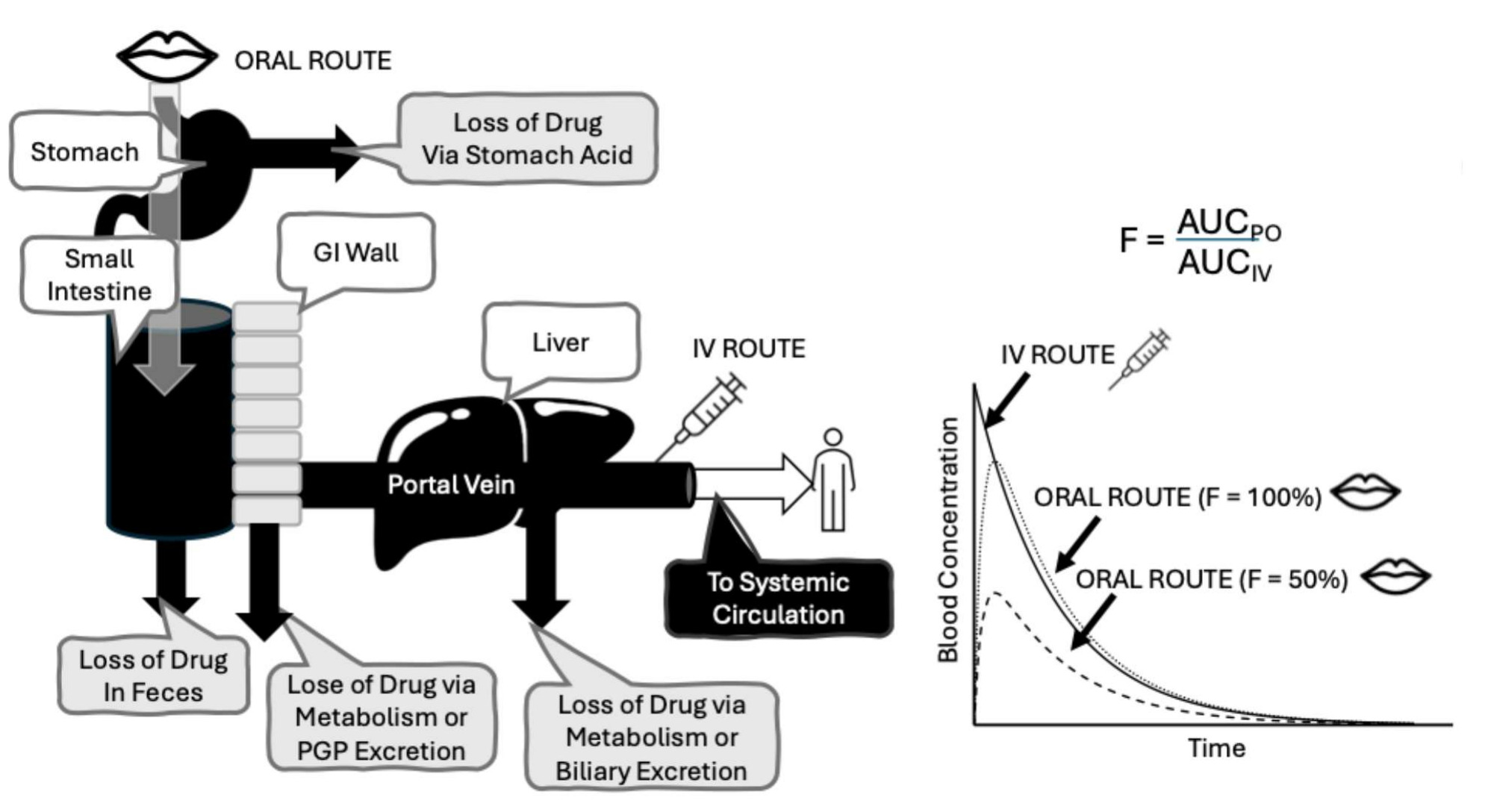
Bioavailability (F) is the proportion of an administered medication that reaches systemic circulation (i.e., blood). Absolute F is the AUC after oral administration compared to the AUC after IV administration (see Figure 1). Inter-individual variability in F presents challenges in the clinical setting when converting medications from IV to non-IV routes involving absorption, or vice versa.

Clinical Application
The oral F of immediate-release metoprolol tartrate tablets is 50% in product labeling due to pre-systemic metabolism in the gastrointestinal tract or liver.7 This suggests to a clinician that a patient admitted with high blood pressure would require half the oral dose given IV. This simple conversion is misleading because the range of F may vary from 19% to 54% and the total medication exposure as indicated by AUC does not reflect the dramatic differences in the plasma concentration time curves (and related clinical effects) of oral versus IV administration.8 In other words, with this example of metoprolol, AUC equivalence does not equate to clinical equivalence. Such pharmacokinetic variation may not only necessitate changes in dose but also dosing interval when performing conversions. Therefore, it is preferable to start with a typical IV dosing regimen of 1.25-5 mg every 6-8 hours provided in published literature with subsequent adjustments by clinical response.9 Using a lower IV dose with a more frequent dosing interval should help to maintain a more constant concentration within the therapeutic window, like a sustained oral dosing regimen.
DISTRIBUTION
It is important to note that V is a non-physiological parameter that reflects the total amount of medication in the body using a unit such as mg to its concentration in blood in a unit such as mg/L, which in this example yields a value in L. Because V is a theoretical volume not an actual physical space in the body, it is often referred to as the apparent V. The apparent V is the most important parameter for estimating blood concentrations of medications given as a single IV bolus (such as a loading dose) or by non-sustained intermittent IV bolus dosing as indicated by one of the simplest calculations in pharmacokinetics, the one-compartment IV bolus dose equation, in which maximum concentration = dose/apparent V. The complexity of the equation for estimating concentration only changes if the clinician is interested in estimating the concentration of a dose at some point beyond the maximum concentration or when the frequency of intermittent IV bolus dosing results in medication accumulation.
Clinical Application
Assume a clinician is caring for a patient with acute kidney injury requiring the initiation of renal replacement therapy. For suspected sepsis, the patient is going to receive a 2-hour IV infusion loading dose of the antimicrobial vancomycin, an antibiotic with elimination by the kidneys. The vancomycin was originally intended for administration as a loading dose given after the first hemodialysis session with subsequent maintenance doses given after each hemodialysis session. However, with a delay in the initial hemodialysis session until the next day the decision is made to administer the loading dose of vancomycin as soon as possible. This raises the question as to whether the blood concentrations of vancomycin after the loading dose will be adequate for treating the infection until the hemodialysis session occurs. In contrast to the usual vancomycin half-life of 4 to 6 hours, its half-life is likely several days in this example due to the acute kidney injury so an inconsequential amount of vancomycin undergoes elimination until the dialysis session the following day. Considering the distribution of vancomycin following the loading dose in conjunction with the prolonged half-life, there is no need for the patient to receive additional doses of vancomycin prior to hemodialysis. Of note, because of redistribution of drugs and fluids that occurs during and soon after hemodialysis, at least a 2-hour delay in sampling post-dialysis is appropriate when obtaining blood concentrations of medications for analysis.10
Protein Binding
Clinical laboratories typically report bound plus unbound drug referred to as total drug concentrations when such monitoring is available. The unbound fraction of a medication is responsible for pharmacological effects of acidic drugs such as phenytoin for seizure control, or warfarin to prevent or treat blood clots that bind to albumin and basic drugs such as the antiarrhythmics lidocaine, propranolol, verapamil that bind to alpha-1 acid glycoprotein. Alpha-1 acid glycoprotein in the blood increases during inflammation.11 Protein binding interactions with albumin tend to receive more attention because in contrast to alpha-1 acid glycoprotein, albumin concentrations are commonly available for monitoring in clinical settings. The importance of drug-drug protein binding interactions at times is overstated even for highly bound agents such as phenytoin because with changes in protein binding of a medication there are usually concomitant changes in distribution and Cl that keep the free fraction relatively unchanged.12 In such circumstances, total drug concentration is reduced due to the reduction in the albumin-bound portion. However, interpreting the total phenytoin concentration as usually reported by clinical laboratories in the setting of hypoalbuminemia can be confusing to clinicians because the total concentration may appear to be subtherapeutic even when the free active concentration is in the therapeutic range. This has led to the development of correction equations to allow clinicians to adjust the total phenytoin concentration so the usual therapeutic range remains applicable for monitoring. However, because such equations have not been well validated, monitoring of free drug concentrations is more appropriate in critically ill patients,13 particularly for medications not amenable to titration to clinical effect.14
METABOLISM
The most common site of medication metabolism is the liver. There is less information concerning medication prescribing in patients with liver disease compared to medication adjustments for patients with kidney dysfunction; however, medications with substantial hepatic elimination may require dose adjustment or discontinuation. In addition to prescribing lower doses for shorter courses or avoiding potentially hepatotoxic medications such as acetaminophen in patients with cirrhosis, some medications are best avoided due to their possible adverse effects on other organ systems. Examples include nonsteroidal anti-inflammatory drugs such as ibuprofen and naproxen that may precipitate kidney injury or gastrointestinal bleeding in critically ill patients prone to such complications. Dosing hepatically-eliminated medications in patients with liver disease is usually based on the Child-Turcotte-Pugh score that assesses the severity of cirrhosis based on encephalopathy, ascites, serum bilirubin, serum albumin, and prothrombin time or INR. This information yields subsequent classification into A, B, or C categories with C being the most severe disease.15
Clinical Application
A patient with a history of receiving sublingual buprenorphine for opioid use disorder transfers to an intensive care unit following surgery for trauma. A physician enters an order to continue the patient’s buprenorphine since the patient is conscious and has no oral injury that would preclude its administration. However, the attending physician questions the clinical pharmacist regarding the continuation of buprenorphine since the opioid undergoes hepatic metabolism and the patient has liver disease with a Child-Turcotte-Pugh Class C score.16 Both the physician and pharmacist recognize the importance of continuing the buprenorphine to prevent relapse and avoid withdrawal. In this scenario the pharmacist recommends continuing the buprenorphine since there is evidence that it is safe with careful monitoring in patients with severe liver disease.17
ELIMINATION
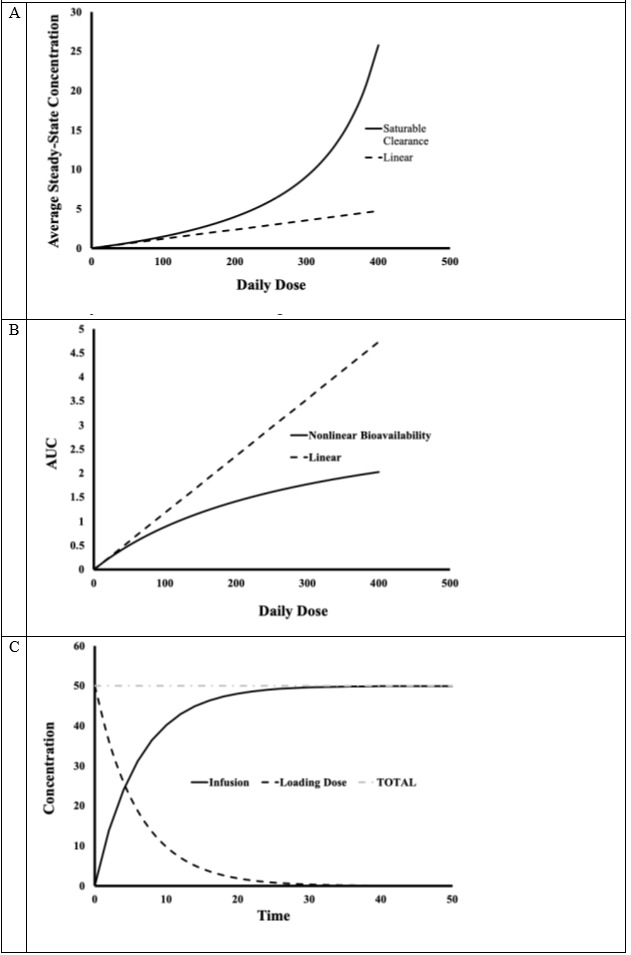
Elimination is the process in which the body irreversibly removes medications by metabolism or excretion. Excretion most commonly occurs through the kidneys. Most medications exhibit linear or first-order pharmacokinetics, which means there is a proportional relationship between dose and exposure as usually noted by blood concentration or AUC. Elimination occurs as a constant fraction over time. For example, a doubling of the dose should yield a doubling of a medication’s blood concentration or AUC, although not necessarily its pharmacological effects.
Non-linear or zero-order pharmacokinetics usually occur when there is saturation in absorption, protein binding, or Cl. With non-linearity, saturable elimination occurs such that pharmacokinetics becomes zero-order resulting in accumulation and disproportionality between dose and exposure. For example, a doubling of dose would result in more than a doubling in blood concentration. Only a few small molecule medications commonly used in clinical practice such as phenytoin to control seizures and the antifungal voriconazole are known to exhibit non-linear or zero-order pharmacokinetics.18 See Figure 2 for an illustration of the concepts of linearity and non-linearity.

The introduction of large molecule therapeutic agents presents challenges for designing dosing regimens since these agents often have high affinity for their target receptors possibly leading to non-linear pharmacokinetics.19 For large molecules such as monoclonal antibodies used to treat cancer, any non-linearity associated with absorption, distribution, metabolism, or excretion yields a non-proportional relationship between medication dose and pharmacokinetic parameters. A doubling of the dose of a medication with non-linear pharmacokinetics due to a saturation of Cl would yield more than a doubling of exposure as the saturation process occurs.
Clinical Application
Assume a hospitalized adult patient is receiving phenytoin at a dose of 100 mg three times daily for seizure prophylaxis in a patient with traumatic brain injury. After 3 days of therapy, the patient’s total blood phenytoin level is 5 mg/L with a usual therapeutic range of 10 to 20 mg/L. Phenytoin is highly bound to albumin and this may be a concern in patients with hypoalbuminemia but this patient’s albumin level is in the normal range. Because phenytoin has saturable hepatic elimination, a doubling of the dose to 200 mg three times daily would not lead to a doubling of the phenytoin level to 10 mg/L. Rather, a doubling or more of the phenytoin dose in this scenario could easily lead to levels in the toxic range. Therefore, in the case of phenytoin, maintenance dose increases in adults exceeding 100 mg/day are rarely justifiable. Fortunately, phenytoin is one of only several medications that exhibit nonlinear saturable kinetics within usual therapeutic ranges leading to levels that are not proportional to dose adjustments.
Clearance and Steady State
Clearance is a constant that links elimination to blood concentration by measuring the volume of blood cleared of medication per unit of time. Total systemic Cl of a medication is a function of renal and non-renal elimination. Notice that the latter parameter is non-renal, not hepatic elimination, but hepatic can be a major contributor. In other words, metabolism and elimination are not the same thing. Opioids such as morphine undergo metabolism by the liver but excretion by the kidneys; this is an important distinction for morphine since it has an active metabolite excreted by the kidneys. The units of Cl are volume over time such as mL/minute or L/hour, not amount over time; Cl is a measure of flow like blood flow. While most medications have elimination by the kidneys or liver, or a combination thereof, there are medications that undergo extrahepatic metabolism in a variety of other organs such as the depolarizing neuromuscular blocking agent succinylcholine commonly used for rapid sequence intubation that has rapid elimination by pseudocholinesterase in the blood.20
The concept of steady state is important not only for the small number of medications amenable to therapeutic drug monitoring in the clinical setting, but also for designing dosing regimens and estimating the time for medication elimination from the body after discontinuation. Medications amenable to therapeutic drug monitoring typically require steady state conditions for appropriate interpretation of blood concentrations. Medications with prolonged Cl and subsequently long half-lives will take a long time to reach a steady state. Loading doses of medications provide a more rapid therapeutic effect in such circumstances but will not hasten the time to steady state. For medications with first-order elimination, steady state conditions occur when the amount of medication administered is equal to the amount of medication cleared or eliminated, or rate in equals rate out. Steady state occurs after approximately 4 half-lives (1 half-life = 50%, 2 half-lives = 75%, 3 half-lives = 87.5%, and 4 half-lives = 93.8% of steady state); therefore, the time to reach steady state concentrations can vary from a couple of minutes to months. For example, the opioid remifentanil administered as a continuous IV infusion can be rapidly titrated to steady state conditions due to its rapid metabolism (elimination half-life of less than 10 minutes in healthy volunteers) by plasma esterases.21 In contrast, with constant oral dosing of the antiarrhythmic amiodarone, steady state conditions of the parent compound would not be reached for 130 to 535 days (terminal elimination half-life ranging from 26 to 107 days) due to slow elimination from poorly perfused tissue such as fat.22 The time to reach steady state conditions for amiodarone is further complicated by the active metabolite desethylamiodarone with an elimination half-life of approximately 61 days.
The time to reach steady state concentrations has implications for the route of medication administration. Medications with rapid onsets of action and high Cl such as the vasopressor norepinephrine require administration by continuous IV infusion when a sustained clinical response is desirable. However, a medication administered by continuous IV infusion does not necessarily mean that it has a rapid onset and offset of action. For example, labetalol is available in an injectable form used to treat high blood pressure that has a recommended starting dose of 2 mg/minute administered as a continuous IV infusion with dosage adjustments based on blood pressure.23 A common clinical scenario would be to increase the IV infusion rate until the desired blood pressure is achieved and then maintain the infusion at that rate; but, labetalol has a half-life of 5.5 hours in contrast to the 2.5 minute half-life of norepinephrine. Therefore, labetalol accumulation will continue to occur assuming no change in the rate of infusion until achievement of steady state, which would be approximately 24 hours. Close monitoring of blood pressure is necessary in this situation since the infusion may require downwards adjustment or discontinuation in conjunction with medication accumulation.
Kidney Function
The kidney is the primary organ of elimination of most medications from the body. Medications with more than 30% elimination by the kidneys (or less with medications with a narrow therapeutic index or active metabolites after processing by the liver) are likely to need adjustment with kidney dysfunction. Additionally, some medications not only require adjustment in patients with kidney dysfunction but also have concerns related to nephrotoxicity that may necessitate discontinuation. This includes commonly used antibiotics such as antistaphylococcal penicillins and cefazolin useful for the treatment of methicillin-susceptible Staphylococcus aureus.24
A measured glomerular filtration rate (GFR) is the most useful index of kidney function, but such measurements require specialized testing and personnel and are not available in many clinical settings, which limit their use in most clinical settings to exceptional circumstances such as the need of accurate measurement of GFR in a kidney donor. Therefore, estimates of GFR (eGFR) using creatinine, cystatin C, or a combination of creatinine and cystatin C are commonly employed for assessing chronic kidney disease (CKD), acute kidney injury (AKI), or the progression of CKD or AKI. Cystatin C testing is not widely available so eGFR determinations by clinical laboratories usually involve serum creatinine. Clinicians should recognize that assessments of kidney function based on serum creatinine vary by factors such as age, gender, and muscle mass; they are difficult to interpret when changes are occurring quickly such as in critically ill patients.
CHANGES IN PHARMACOKINETIC PARAMETERS OVER TIME
For many medications that have their site of action on the CNS, the duration of action of an IV bolus dose is short due to redistribution from its site of action in the CNS to other body compartments and not from elimination by hepatic metabolism. Elimination from the body becomes an important parameter for duration of action with sustained dosing, but elimination half-life and associated clinical effects also may change over time.
Clinical Application
The opioid fentanyl serves as a useful illustration of how the pharmacokinetics and associated clinical effects of a medication may change over time. Assume a critically ill patient receives a continuous IV infusion of fentanyl at 100 mcg/hour for severe pain associated with multiple traumatic injuries. The orders allow for the nurse to titrate the fentanyl infusion for pain control. During the first few hours after the fentanyl infusion begins, the patient continues to complain of severe pain despite increases in the infusion dose. The 30-to-60-minute duration of action of an IV bolus dose of fentanyl is short due to redistribution from its site of action in the CNS. Therefore, the patient’s ongoing pain is not surprising since there were no titrated bolus doses of fentanyl and it takes time for the infusion to lead to therapeutic levels in the CNS. Ideally, this patient should have received a series of mini-boluses of fentanyl given frequently (e.g., 50 to 100 mcg every 15 minutes) until pain was less severe while waiting for the infusion to lead to sufficient accumulation for therapeutic effect. The elimination half-life of IV fentanyl according to prescribing information is 219 minutes,25 but was 13 hours in a patient on a fentanyl infusion for 9 days. Cl values in the latter patient were like those reported in healthy volunteers suggesting that the cause of the prolonged half-life was a substantial increase in V associated with distribution into slower perfusing tissue compartments. Clinicians need to be aware of the potential for fentanyl accumulation with prolonged infusions leading to much longer durations of therapeutic and potentially toxic effects that can occur even after stopping the fentanyl.26
CONCLUSION
While the focus of pharmacokinetic resources tends to be math, understanding the concepts behind math is often more vital. These concepts include absorption, distribution, metabolism, and elimination. Absorption is a concept important for anticipating a medication’s onset of action and peak effect. Distribution represents how the amount of medication in the body relates to its measured concentration, which can impact factors such as the size of a loading dose needed to yield a therapeutic concentration. Metabolism of selected medications by the liver alters their composition prior to elimination by the body and is an important consideration in patients with liver dysfunction who may need reduced doses. Reduced doses may also be appropriate in patients receiving medications eliminated by the kidneys when kidney dysfunction is present. Clinicians should understand and apply these concepts to the care of their patients.
Funding
No funding was received in the form of grants.
Conflicts of interest
No conflicts of interest.
Ethics/IRB
Not applicable.
Author Contributions
Brian Erstad: Conceptualization, Methodology, Investigation, Writing - original draft, Writing - review & editing
Adam Persky: Conceptualization, Methodology, Investigation, Writing - original draft, Writing - review & editing