Introduction
Bacteremia is one of the leading causes of death in North America.1 The results of blood cultures are crucial for identifying bloodstream infections and guiding antimicrobial treatment. Unfortunately, blood cultures can become contaminated and result in false positive growth that can lead to inappropriate antimicrobial usage, unnecessary hospital stays, and increased healthcare costs.2
Blood culture contamination generally occurs when normal skin flora of the patient comes in contact with the needle as it passes through the skin and into the vein. Common contaminant species of bacteria identified in blood cultures include coagulase-negative staphylococci (CoNS), Corynebacterium species, and Bacillus species, with the exception of B. anthracis.3 Patients with blood cultures resulting positive for these organisms often due to contamination do not need antibiotic treatment.
In January 2024, our institution implemented a policy to provide a system for the follow-up of blood cultures drawn in the ED for patients discharged or transferred directly from the ED. Prior to the implementation of this policy, all patients seen and discharged from the ED were contacted for return to the ED for additional evaluation, regardless of the microorganism identified. Anecdotally, these patients would often have repeated blood cultures drawn and empiric intravenous antibiotics started. This process applied to patients whether they had resulted positive for contamination or true infection.
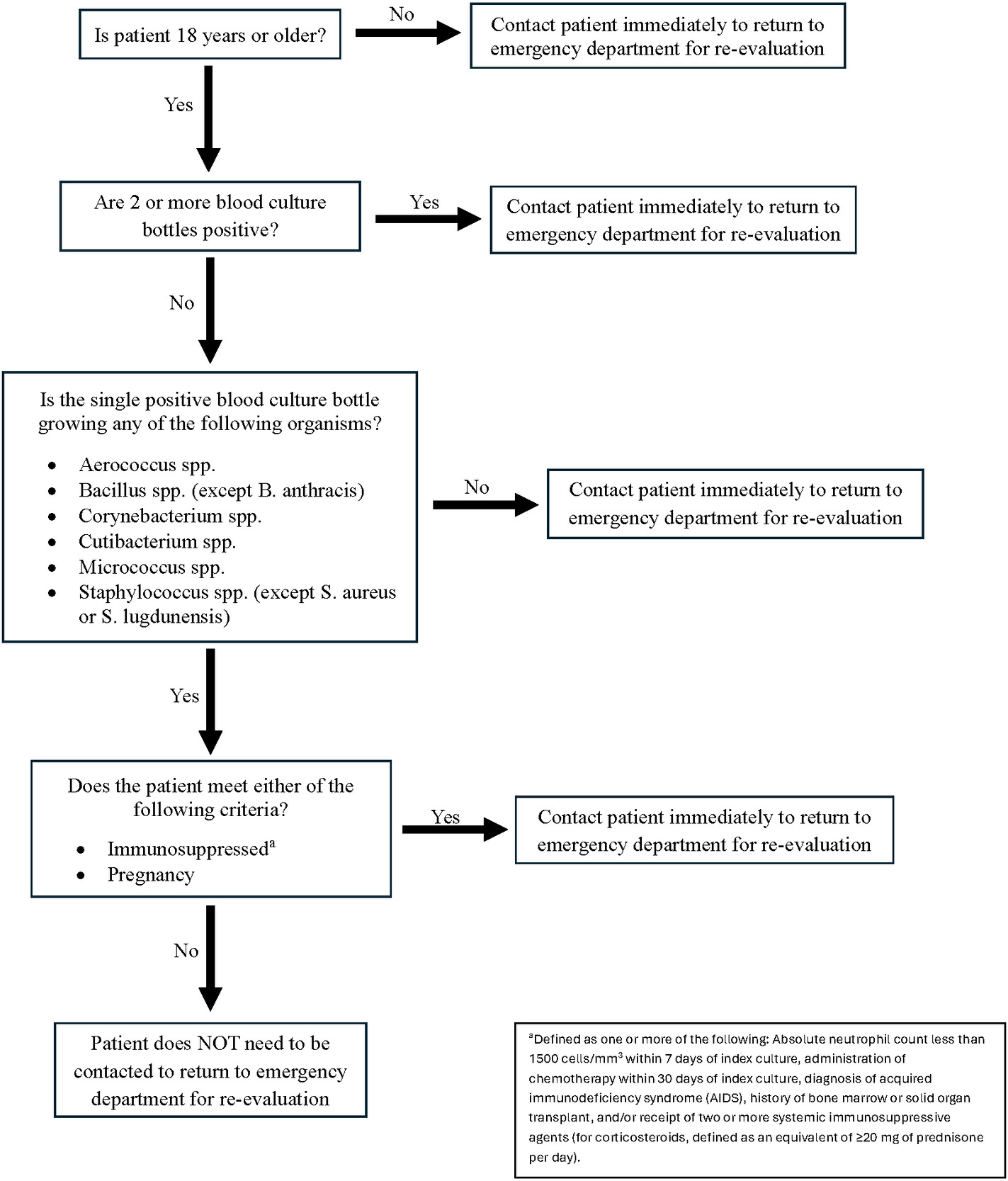
With the implementation of the current policy, patients with positive blood cultures are contacted to return to the ED for evaluation if the final blood culture grows a bacterium or fungus not pre-defined as a contaminant, they are younger than 18 years, two or more blood culture bottles are positive, or they are immunosuppressed or pregnant (Figure 1). Patients with a single positive blood culture bottle growing a pre-defined contaminant who do not meet any of these criteria are not contacted to return for re-evaluation. The implementation of this protocol aimed to reduce the use of unnecessary ED resources, improve ED throughput, and decrease the use of unnecessary antibiotics.
Methods
This was a multi-center, retrospective, cohort pre-/post-implementation analysis of an emergency medicine (EM) pharmacist-driven blood culture assessment algorithm for patients discharged directly from the ED. The first study site, SwedishAmerican Hospital (SAH) ED, is a 48-bed ED and designated level II trauma center in Rockford, Illinois, that sees ~75,000 visits per year. The second study site is Belvidere Hospital (BEH) ED, a 5-bed ED that sees ~13,000 visits per year and is located in Belvidere, Illinois. This study was approved by the local institutional review board.
Positive cultures for patients seen and discharged from either SAH ED or BEH ED are reviewed by an EM pharmacist. In addition to blood cultures, urine cultures, abscess swabs, sexually transmitted infection panels, and hepatitis panels are reviewed. These additional microbiology results are part of the pharmacist’s routine workflow but were not evaluated in this study. Positive cultures are routed to an in-basket where an EM pharmacist reviews the culture, completes a chart review of the index ED visit, and assesses for antimicrobial appropriateness. If antimicrobial therapy needs to be adjusted, the pharmacist contacts the patient via a documented telephone encounter, enters a new prescription, and forwards the encounter and prescription to an advanced practice provider for prescription signoff. Prior to the implementation of this algorithm all patients with at least one positive blood culture bottle were called by an EM pharmacist with instructions to return to the ED for re-evaluation. After the implementation of this algorithm, patients are only called to return to the ED by an EM pharmacist if they meet pre-defined criteria (Figure 1).
Patients in our study were eligible for inclusion if they were 18 years old or older, were seen and discharged from SAH or BEH ED between July 16, 2023 and July 16, 2024, and had a single positive blood culture bottle from their ED visit with a final culture growing an organism pre-defined as a contaminant. Preliminary molecular panel detections that were not confirmed on final culture were not used to determine eligibility. These organisms included Aerococcus species, Bacillus species (except B. anthracis), Corynebacterium species, Cutibacterium species, Micrococcus species, and CoNS (except S. lugdunensis). The pre-group included patients from July 16, 2023 to January 15, 2024, and the post-group included patients from January 16, 2024 to July 16, 2024. A documented attempted callback was also required for inclusion in the pre-implementation group. Patients were excluded if they were admitted during the index encounter or transferred to an outside facility, were immunosuppressed or pregnant, had two or more positive blood culture bottles, or had concomitant growth of an organism not pre-defined as a contaminant. Patients outside the study period were also excluded. Data points were collected through a manual chart review and included demographics, blood cultures drawn during ED visit, organism grown on initial and repeat cultures, initial ED visit date, return ED visit date, hospital admission, and hospital length of stay. Records were also reviewed for the documented presence of wounds, vascular access, and implanted hardware or prostheses. These factors were not included as criteria within the blood culture callback algorithm and did not affect study eligibility. Between the two study periods blood culture collection processes remained the same at both SAH ED and BEH ED.
The primary endpoint of this study was the estimated number of annual callback-associated ED return visits avoided by implementation of this algorithm. A callback-associated return was defined as an ED return prompted by notification of the positive blood culture. Secondary endpoints included the estimated number of hospital admissions avoided annually, estimated number of hospital days avoided annually, the frequency of positive repeat blood cultures in the pre-implementation group, and the number of patients in the post-implementation group who returned to the ED within 7 days of their index blood culture. Annual estimates were calculated by multiplying the 48 eligible patients identified during the 12-month study period by the absolute difference between the pre- and post-implementation proportions for each outcome. For hospital days, total inpatient time from callback-associated pre-implementation admissions was annualized to the full eligible population.
Results
A total of 79 patients were screened for study inclusion. After applying exclusion criteria, there were 31 and 17 patients included in the pre- and post-implementation groups, respectively. There were 22 patients excluded in the pre-implementation group. Reasons for exclusion included patients transferred to an outside facility (n = 10), concomitant growth of an organism not pre-defined as a contaminant (n = 4), two or more positive blood culture bottles (n = 3), admission during the index encounter (n = 2), underlying baseline immunosuppression (n = 1), outside the study period (n = 1), and no documented attempted callback (n = 1). For the 9 patients in the post-implementation group that were excluded, reasons for exclusion were transfer to an outside facility (n = 5), admission during the index encounter (n = 2), underlying baseline immunosuppression (n = 1), and pregnancy (n = 1). Baseline characteristics varied between the groups and are described in Table 1. On average, patients in the pre-group were older (56.3 vs. 34.9 years) and more often male (58.1% vs 41.2%). The most common contaminant organisms grown on index blood cultures in both the pre- and post-implementation groups were CoNS (67.7% and 88.2%, respectively). Multiple contaminants were identified in 2/31 (6.5%) and 1/17 (5.9%) patients in the pre- and post-implementation group, respectively. Documented wounds, vascular access, or implanted hardware/prostheses were present in 10/31 (32.3%) patients in the pre-implementation group and 4/17 (23.5%) patients in the post-implementation group. In the pre-implementation group, 2 (6.5%) patients had a documented wound, 2 (6.5%) had an arteriovenous fistula for hemodialysis, and 6 (19.4%) had implanted hardware or a prosthesis. Corresponding frequencies in the post-implementation group were 1 (5.9%), 2 (11.8%), and 1 (5.9%), respectively.
In the pre-implementation group, 22/31 (71.0%) patients returned to the ED after being contacted about the positive blood culture. Four of these 22 patients (18.2%; 12.9% of the full pre-implementation group) were admitted specifically because of the positive blood culture. For these four admissions, mean inpatient length of stay was 56.6 hours, median length of stay was 62.0 hours, and the range was 23.8 to 78.6 hours; total inpatient time was 226.3 hours (9.4 days). The remaining 18 patients in the pre-implementation group who returned to the ED but were not admitted had an average ED length of stay of 3.9 hours (range 1.6-10.8). Repeat blood cultures were collected in all 22 patients who returned to the ED for re-evaluation in the pre-implementation group and none of the repeated blood cultures resulted positive for the index organism. One additional patient returned independently for a noninfectious reason before being contacted, was subsequently admitted, and received antibiotics; this encounter was not included in the callback-associated estimates.
In the post-implementation group, 3/17 (17.6%) of patients returned to the ED within 7 days of their index visit. None of the 17 patients met protocol criteria for callback. Despite this, two patients were contacted outside the protocol without a valid protocol-based indication, one by a physician and one by a pharmacist. The patient called back by the physician grew Micrococcus luteus in one out of two blood cultures. The patient called back by the pharmacist grew Staphylococcus hominis. Both patients returned to the ED for repeat cultures and were discharged home without admission. Repeat blood cultures for both patients were negative. The third patient returned to the ED for a medical condition that was unrelated to their positive index blood culture. None of the three patients were admitted to the hospital. Two of these patients had repeat blood cultures drawn and both had negative growth for the index organism.
Over the 12-month study period there were 48 patients who met study criteria. Using the difference in callback-associated return rates between the pre- and post-implementation groups (22/31 [71.0%] vs. 2/17 [11.8%]), an estimated 28.4 callback-associated ED return visits were avoided annually. Based on callback-associated admission rates of 4/31 (12.9%) and 0/17 (0%), an estimated 6.2 hospital admissions were avoided annually. Annualizing the 226.3 inpatient hours observed among the four callback-associated pre-implementation admissions yielded an estimated 14.6 hospital days avoided annually. Primary and secondary endpoints are summarized in Table 2.
Discussion
Previous literature regarding the use of blood culture algorithms is limited. Most literature focuses on preventing blood culture contamination before the cultures are drawn or reviews blood culture algorithms in already hospitalized adults. In 2024, Theophanous and colleagues published a pre- and post-intervention study reviewing a blood culture algorithm developed for use in the ED. This algorithm assisted providers in determining blood culture utility in hopes of decreasing blood culture events without increasing the number of safety events. The researchers found that the implementation of their algorithm led to a decrease in blood culture contamination, no increase in safety events, and lower ED and hospital readmission rates.4
In a 2023 study by Brenneman and colleagues, researchers completed a retrospective study reviewing the impact that the presence of an EM pharmacist has on the time to attempted contact for patients discharged from the ED with positive blood cultures resulting after their visit. When a pharmacist was on-duty, positive blood culture results were called to the EM pharmacist. During off-duty hours, positive results were called to the ED charge nurse who then notified the ED attending. Patients were contacted regarding their positive results and advised to return to the ED. The study found the time to first attempted patient contact to be significantly shorter when an EM pharmacist was present, supporting the role for pharmacists in managing blood cultures after ED discharge.5 In a separate study, Waters and colleagues compared pharmacist-managed with physician-managed follow-up of patients discharged from the ED with true bacteremia and found lower readmission rates among pharmacist-managed patients. Although that study evaluated true bacteremia rather than presumed contamination, its findings further support pharmacist-directed culture follow-up.6
Similar to the above study, our institution’s protocol is pharmacist-driven. Our EM pharmacists review positive blood cultures and contact patients for return if indicated. Although most literature often stems from physician/advanced practice provider (APP) ordering practices or through culture draw technique, our study offers guidance for patients with positive blood cultures that result after ED discharge. This study also provided us with information regarding our own institution’s practice. No blood-culture-related adverse outcome was identified in the available institutional records. This finding supports continued use of the algorithm but must be interpreted in light of incomplete follow-up outside the study health system. Although no inferential statistical testing was performed because of the limited sample size, the observed reductions in callback-associated ED return visits, hospital admissions, and inpatient days were clinically relevant. These results potentially assist in the prevention of inappropriate antimicrobial use and the reduction of costs for both the institution and the patients. Additionally, a similar follow-up pathway may be applicable to patients discharged from an inpatient unit before blood culture results are finalized.
This study has several limitations. First, not every patient followed the implemented algorithm as written. Two post-implementation patients were called back outside the protocol even though neither met callback criteria. Next, several patients in the pre-group were lost to follow-up. Ideally, all included patients in the pre-group should have returned for evaluation. Many of the patients were unable to be contacted via telephone for return. Other reasons for loss of follow-up included residing in a nursing home facility, returning to an outside hospital, and physician requests to not have the patient return. The loss of these patients affects the annual estimates because outcomes among patients who were not reached or did not return could not be observed, potentially resulting in over- or underestimation of avoided admissions and hospital days. Subsequent encounters and adverse outcomes occurring outside SAH and BEH were not accessible through the electronic medical record or health information exchange and therefore may not have been captured. Although wounds, vascular access, and implanted hardware/prostheses were assessed, these characteristics were not incorporated into the callback algorithm. The study was not designed to determine whether these factors independently increase the likelihood that a positive blood culture represents true bacteremia, and their presence should be considered when applying these findings to higher-risk patients. Another limitation is that our study is a retrospective chart review. This limits the ability to understand why patients were cared for against protocol – by either returning or not returning to the ED. Lastly, our study included a small sample size, limiting generalizability.
Conclusion
Blood cultures are useful tools to assist in identifying bloodstream infections and guide appropriate antimicrobial therapy. Implementation of the algorithm was associated with fewer callback-associated ED return visits, hospital admissions, and days of inpatient stay. No blood-culture-related adverse outcomes were identified in the available institutional records; however, outcomes occurring outside the study health system could not be assessed. These findings support optimization of health-system resource use while maintaining a structured approach to blood culture follow-up.
Data availability
The data underlying this article are available in the article.
Disclosures
The authors have declared no potential conflicts of interest.
Author Contributions
-
Madeline P. Wermeling: Investigation, Project administration, Visualization, Writing – original draft, Writing – review & editing
-
David Huhtelin: Conceptualization, Supervision, Visualization, Writing – review & editing
-
Veronika Yurchenko: Supervision, Visualization, Writing – review & editing
-
Kirk Schubert: Supervision, Visualization, Writing – review & editing
-
Mark Biagi: Conceptualization, Data curation, Formal analysis, Project administration, Supervision, Visualization, Writing – review & editing
All authors have read and approved the final version and are accountable for all aspects of the work.