Introduction
Inhaled pulmonary vasodilators are a mainstay of treatment for patients with severe pulmonary hypertension. Inhaled prostacyclins and inhaled nitric oxide (iNO) are utilized to vasodilate pulmonary vasculature but are associated with significant negative hemodynamic effects if they are abruptly withdrawn.1,2 Herein, a case of abrupt withdrawal of iNO resulting in significant decompensation and temporization with inhaled nitroglycerin (iNTG) is described.
Methods
Authorization for use or disclosure of protected health information for publication purposes was obtained from the patient prior to the writing of this case report in accordance with hospital and institutional review board policies.
Case
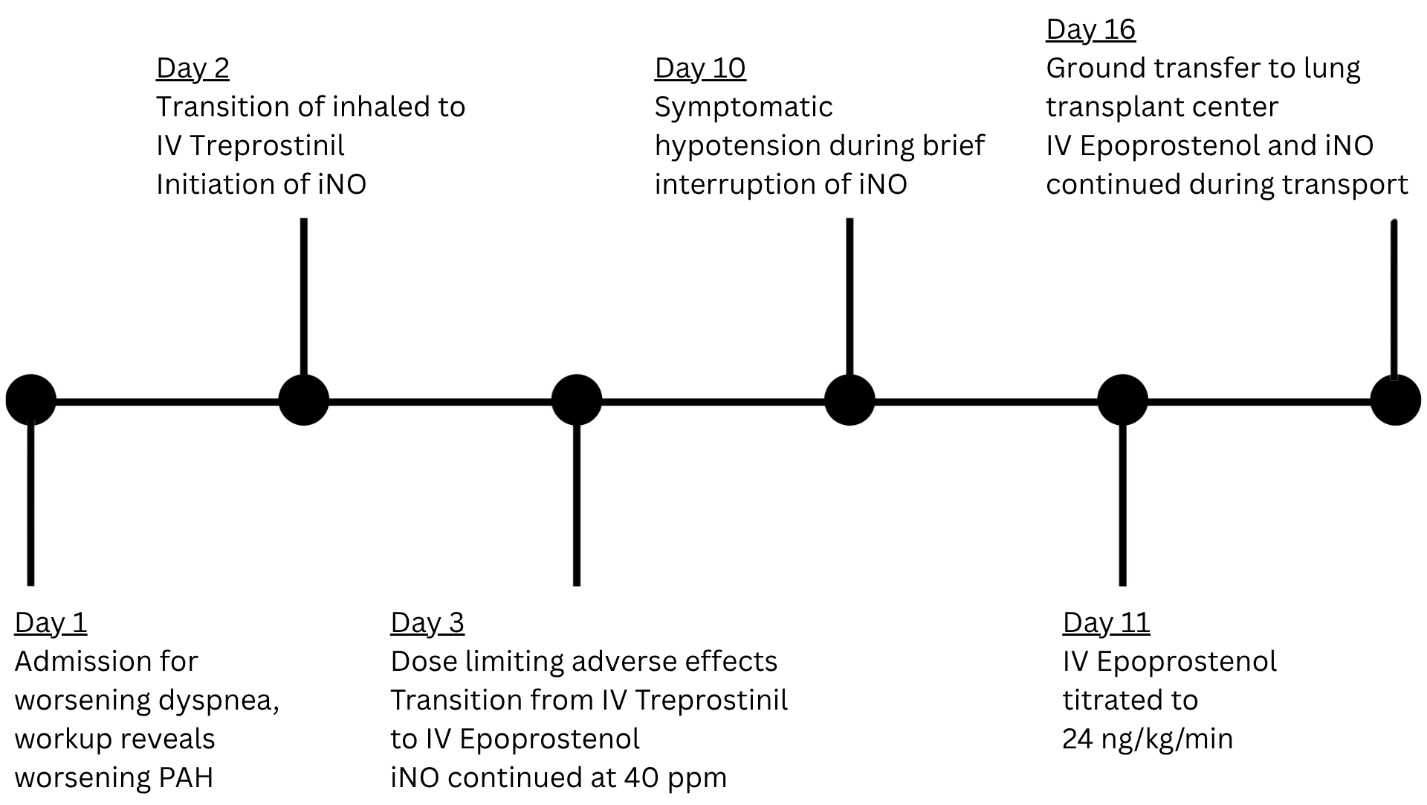
A 52-year-old female with medical history significant for group 1 and group 3 pulmonary hypertension, interstitial lung disease related to systemic lupus erythematosus and scleroderma presented as a transfer for lung transplant evaluation. The patient’s home pulmonary hypertension regimen included riociguat 2.5 mg three times daily and treprostinil dry powder 48 mcg inhaled four times daily. Progressively worsening dyspnea over six months led to further workup, including a transthoracic echocardiogram demonstrating severe dilation of the right atria and right ventricle. The patient was admitted to an outside hospital for additional workup including right heart catheterization that revealed mean pulmonary artery pressure of 67 mm Hg.
Considering the severe pulmonary hypertension and worsening dyspnea despite the patient’s home regimen, the decision was made to transition treprostinil from inhaled to intravenous route. On outside hospital day 3, the patient developed body aches, emesis, dyspnea, and headaches after transitioning to intravenous treprostinil. The patient was subsequently transitioned to intravenous epoprostenol at 24 ng/kg/minute and iNO 40 parts per million (ppm) via high-flow nasal cannula (HFNC). Methemoglobin concentrations were measured and remained within acceptable limits throughout the hospital course.
On outside hospital day 10, an episode of significant hypotension was noted while replacing the epoprostenol infusion which was attributed to her tenuous clinical status. Additionally, a brief interruption to iNO delivery via HFNC to relieve sinus congestion led to significant hypotension requiring uptitration of vasopressors. Upon replacement of HFNC, the patient rapidly returned to baseline.
Transfer to our facility via air ambulance for lung transplant evaluation was arranged, but severe weather necessitated transfer via ground, resulting in a prolonged transport time. Epoprostenol infusion and iNO were continued throughout transportation.
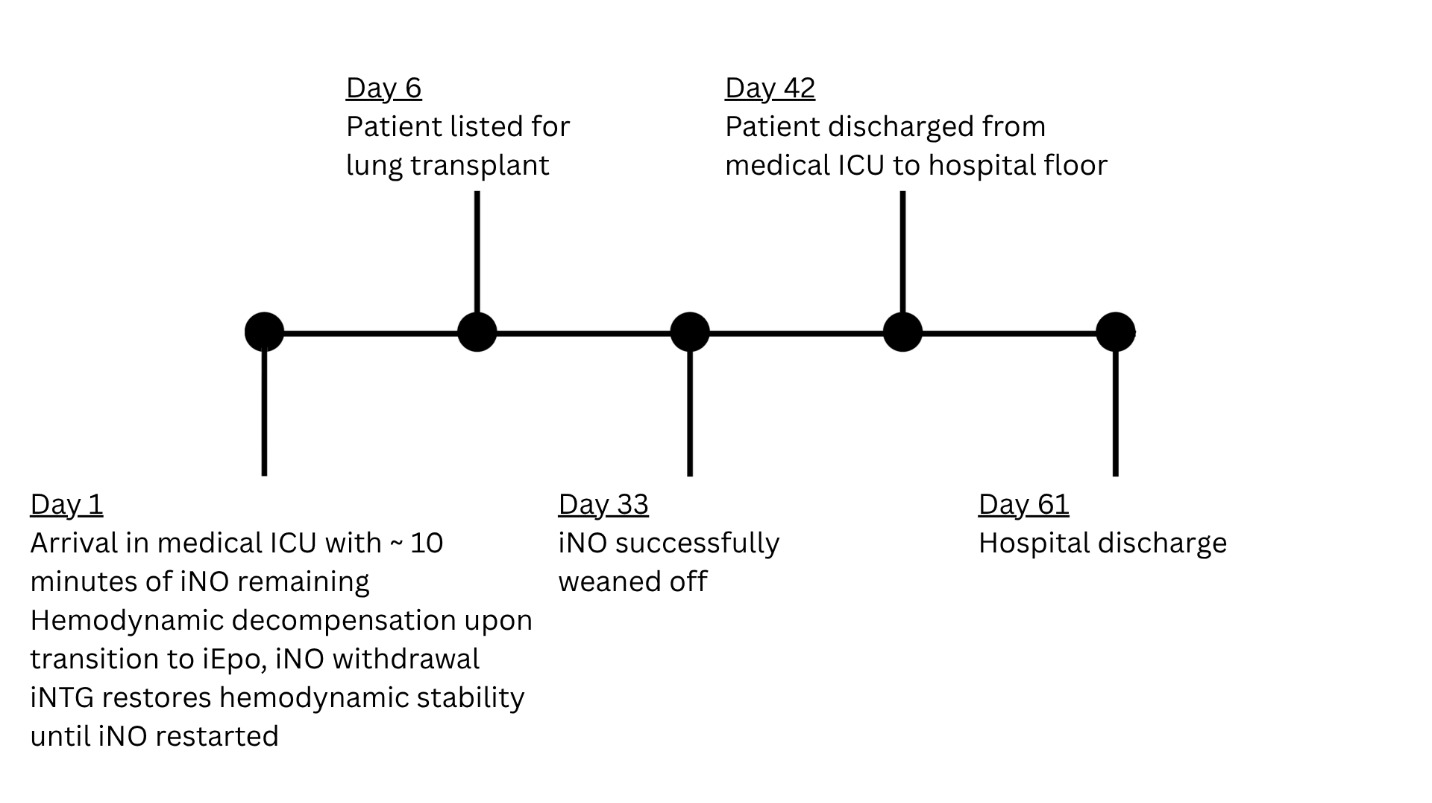
A plan was developed to transition the patient to inhaled epoprostenol (iEpo) upon transfer to the medical ICU, as iNO is not utilized outside of the operating room or neonatal intensive care at our facility. Due to the prolonged transport time, the remaining supply of iNO was critically low; upon arrival to the ICU, the current dose of 40 ppm could only continue for approximately 10 minutes before the supply was exhausted. Intravenous epoprostenol was continued at 24 ng/kg/minute and iEpo was immediately initiated at 50 ng/kg/min.
Upon exhaustion of the iNO supply, the patient became hypotensive (mean arterial pressure 40 mm Hg), requiring titration of phenylephrine to 2 mcg/kg/min and the addition of norepinephrine at 0.6 mcg/kg/min. The patient continued to decompensate with noted tachypnea (respiratory rate 38 breaths per minute), tachycardia (heart rate 156 beats per minute), hypotension (mean arterial pressure 39 mm Hg) and somnolence. This deterioration was attributed to the rapid withdrawal of iNO, and immediate efforts were made to reinitiate the drug.
As a temporizing measure, a vial of nitroglycerin 50 mg/250 mL (200 mcg/mL) for injection was obtained and 5 mL aliquots were administered via nebulization. The nebulizer reservoir was repleted with additional nitroglycerin as the reservoir emptied, approximately every ten minutes, and continued for a total of 30 minutes. Pulmonary hypertension providers were able to successfully advocate for use of iNO within the medical ICU, allowing for reinitiation of this therapy. The patient became more alert and was stabilized until iNO was reinitiated at 20 ppm and iNTG and iEpo were discontinued. No apparent adverse effects of iNTG were observed. Vital signs improved within 5-30 minutes (respiratory rate 22 breaths per minute, heart rate 101 beats per minute, and mean arterial pressure 84 mm Hg), allowing norepinephrine and phenylephrine to be titrated off within two hours.
The patient was listed for a lung transplant on hospital day 6. iNO was successfully titrated off on hospital day 33. Intravenous epoprostenol was titrated to a stable dose of 50 ng/kg/min on hospital day 35. The patient was transferred out of the ICU on hospital day 42 and discharged home while awaiting lung transplant after 61 total days at our facility. A timeline of events at the outside hospital can be seen in Figure 1, and a timeline of events at our facility can be seen in Figure 2.


Discussion
While inhaled pulmonary vasodilators are an important tool for the management of severe pulmonary hypertension, their use comes with significant risk in the case of abrupt withdrawal. Hemodynamic collapse and rebound pulmonary hypertension have been described in case reports and experimental models in both adults and children either with or without chronic pulmonary hypertension.1–3 Not all patients with pulmonary hypertension who have iNO abruptly withdrawn will experience severe adverse effects, especially if the duration of administration is relatively short.1 However, our patient received 15 days of iNO prior to transfer and had two significant events signaling dependence on inhaled and intravenous pulmonary vasodilators, warranting caution with any attempt to wean from the current iNO dose. Importantly, resumption of interrupted iNO or intravenous epoprostenol appeared to rapidly correct withdrawal effects seen in both situations at the outside hospital. Evaluation of this possible adverse drug reaction via the Naranjo algorithm demonstrated a score of seven, which equates to a probable adverse drug reaction (Table 1). Although the Naranjo algorithm was designed to determine if drug exposure was a likely cause of an adverse drug reaction as its primary use case, the authors suggest that use for reactions that appear during drug withdrawal may be appropriate with minor modification, as seen here.4
Inhaled nitroglycerin represents a desirable short-term option for treatment of acute pulmonary hypertension when logistical barriers delay initiation of other agents.5,6 Nitroglycerin for injection is commonly available in critical care areas and in the emergency department, and administration of nebulized medications is possible within all care areas. Nitroglycerin is metabolized by mitochondrial aldehyde dehydrogenase (mtALDH) to nitrite, then activated into nitric oxide, thereby providing the intended compound promptly.7 However, iNTG is not a permanent solution; mtALDH is oxidized and inhibited by the production of nitric oxide, eventually resulting in tachyphylaxis. Although iNTG lacks utility as a long-term solution, it was able to provide ample time for iNO to be obtained and administered in this case. In this clinical scenario, the total duration that iNTG would continue to be effective remains unknown.
The use of iNTG has been described for patients with secondary pulmonary hypertension following valve replacement surgery.8–10 Iloprost, another prostacyclin, was compared to iNTG in a randomized controlled trial in patients who had undergone mitral valve surgery. Both agents effectively reduced mean pulmonary artery pressure and pulmonary vascular resistance compared to patients’ before-treatment baseline, although iloprost was more effective and increased cardiac output and stroke volume.8 A comparative study examined the hemodynamic effects of iNTG, intravenous nitroglycerin, intravenous dobutamine or a combination of these agents after valve replacement surgery. All treatment options were effective in reducing pulmonary vascular resistance, but only iNTG selectively produced pulmonary vasodilation without significant systemic effects.10
Pharmacists play a key role in the interdisciplinary team that manages patients with pulmonary hypertension, particularly when medication regimens are complex and involve multiple high-risk medications.11 In this case, pharmacist intervention was essential to obtain a good outcome in each step of this patient’s hospital stay. Pharmacists on our pulmonary hypertension team assisted in developing the initial transition plan from iNO to iEpo. After initial transition efforts failed, the pharmacists rapidly implemented a rescue strategy while simultaneously maintaining a presence at the bedside throughout the initial stabilization efforts. Pharmacists closely monitored and assisted with medication titration throughout the remainder of the hospital stay. This culminated in a successful hospital discharge to home.
This case report presents a novel option for treatment of acute pulmonary hypertension due to the rapid withdrawal of iNO using iNTG that, to the authors’ knowledge, has not previously been reported in the literature. This case report includes several strengths, including a Naranjo algorithm score correlating to a probable adverse drug reaction and multiple events in which abrupt withdrawal of pulmonary vasodilators resulted in decompensation which resolved after resumption in each instance.
Several limitations must be noted regarding this case. Potentially incomplete charting during the patient’s initial presentation to our facility is a possibility; every effort has been made to accurately report on the events presented, but the significant number of interventions and charting that took place in a short period of time may have limited the amount of information included in the medical record. Additionally, use of the Naranjo algorithm to determine likelihood of an adverse drug reaction related to drug withdrawal is not the primary use case of this tool, but it is likely appropriate with minor modification. While novel, use of iNTG may not be effective or appropriate in all patients with pulmonary hypertension experiencing withdrawal from iNO. Multiple interventions were implemented simultaneously and may have been responsible for improvement in this patient case.
Conclusion
In a case of hemodynamic collapse following the abrupt discontinuation of iNO, iNTG was an effective bridge to resumption of iNO. Additional study is necessary to further characterize the use of iNTG as a rescue agent for acute pulmonary hypertension due to withdrawal from inhaled pulmonary vasodilators.
Author Contributions (ICMJE)
Andrew C DeSio – Conceptualization, methodology, data curation, formal analysis, investigation, project administration, resources, software, supervision, validation, visualization, writing – original draft, writing – review and editing
John A Rubino - Writing – review and editing, visualization
Grace E Benanti - Writing – review and editing
Kaley M Deichstetter - Writing – review and editing
All authors have read and approved the final version and are accountable for all aspects of the work.
Consent for publication
The patient provided written consent to seek publication of this case report.
Acknowledgements
The authors would like to recognize the contributions of the nurses, respiratory therapists, and physicians from Loyola University Medical Center and the transport nurses from University of Chicago Medicine Aeromedical Network for their efforts during this clinical case.
Funding
No external funding was received for this case report.
Conflict of Interest
Andrew DeSio: No relevant financial disclosures or conflicts of interest to report.
John A Rubino: No relevant financial disclosures or conflicts of interest to report.
Grace E Benanti: No relevant financial disclosures or conflicts of interest to report.
Kaley M Deichstetter: No relevant financial disclosures or conflicts of interest to report.